Know what goes into your lot.
Size, moisture and lot records—documented before dispatch. Review our checks and agree the specification your product needs.
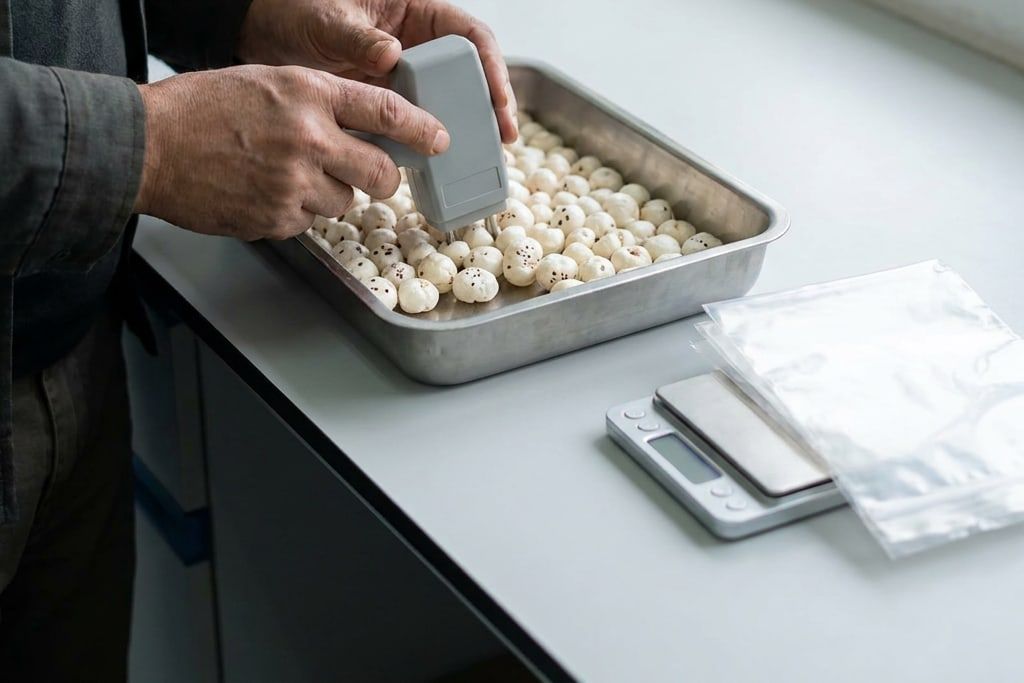
Grading by instrument
Each lot is graded on a 500 g draw taken from several points in the lot, not from the top of one bag. The draw is sized by calliper and sieve, and the share of kernels in each suta band is recorded. That distribution, not just the grade name, goes on the certificate.
One grade stays together through grading and packing. Your certificate records the measured size distribution for that lot.
Moisture, measured twice
Moisture is read on a calibrated meter when a lot comes in and again when it is dispatched, and the meter used is recorded each time. The two readings are kept separately: the gap between them shows how the lot held up in storage, and it is the first thing we check if your reading differs from ours.
The dispatch reading is the one on the certificate: 7% or lower as standard, or 4.5% or lower on the low-moisture spec for 5, 6 and 7 suta.
Laboratory tests
Laboratory work goes to NABL-accredited laboratories.
- Microbiology (total plate count, yeast and mould, Salmonella, E. coli) on every lot of 6 and 7 suta, and on request for 4 and 5 suta.
- Aflatoxin B1 and total on a rotating sample across lots, or on every lot if you ask.
- Pesticide multi-residue by LC-MS/MS on request for 6 and 7 suta.
Aflatoxin gets particular attention. Makhana is harvested from pond beds, dried in the open and stored for months at ambient temperature, and no makhana-specific FSSAI or Codex limit exists. We agree the limit with you in writing rather than assume one.
We make no organic claim on any lot.
The certificate of analysis
The certificate is issued before dispatch, while the lot is still available for a final check.
It shows the lot ID, grade and measured size distribution, dispatch moisture, unpopped, broken and foreign-matter results, whiteness, and any laboratory results for the lot. It carries a content hash, so any change to it after issue is detectable, and a QR code that opens the verification page for that lot.
Retained samples
A sample from every lot is kept for 12 months. If your QC and ours disagree, a coded duplicate goes to a second NABL-accredited laboratory named in the contract in advance. One lot in ten, chosen at random, also goes to a blind duplicate when nobody has disputed it, so we know our own readings hold.
Lot-level traceability
Each lot can be traced back through its processing batch and seed lot to the pond cluster it came from, and forward to the dispatch it left in.
Records retain a history of changes so each sourcing, processing and dispatch entry can be checked.
At procurement
- Seed is weighed on a weighbridge, and the slip is photographed with the time and location recorded.
- The lot and its sample are photographed at intake.
- Growers are paid digitally into bank accounts in their own names, never in cash and never through an agent.
- Each processing batch is reconciled by weight in and weight out before the next batch is released.
Social compliance
Popping and hand-sorting makhana is skilled, traditional work in Mithila, much of it done in household processing clusters. ICRIER's study names child labour as an issue in traditional processing.
Every processing agreement we sign carries a social-compliance clause:
- no workers under 18;
- a signed declaration from the processing unit;
- our right to inspect without notice;
- a photographed workforce record for each shift.
A child-labour finding anywhere in our chain ends that agreement the same day, and we tell our buyers.
Get today's rate
Leave your details. We’ll confirm the grade, current rate and dispatch options by call or WhatsApp.
What happens next
Enquiry received
We will call or WhatsApp you back on the number you gave, with the specification and today's rate.
Continue on WhatsApp