Makhana grades explained: what suta means

Makhana is bought and sold by size. Ask a Bihar trader for 6 suta and you will get a quote; ask exactly what 6 suta means and you may get more than one answer. This guide explains where the term comes from, how it maps to millimetres, and how to write a grade into a purchase order so that both sides mean the same thing.
There is no official grade standard
Start with the gap. There is no BIS, Agmark or FSSAI grade standard for makhana. The grade names in circulation are commercial nomenclature: widely used, broadly understood, and not defined anywhere a dispute could be settled against. That is why the grade on a purchase order has to carry its own definition.
What a suta is
Suta is a traditional unit of size in the Bihar makhana trade. The Institute for Social and Economic Change (ISEC Policy Brief 70) puts one suta at 3.175 mm, which is one-eighth of an inch. A kernel’s grade in suta is its diameter counted in those units, so a 6 suta kernel is about three-quarters of an inch across.
The trade also has its own names for size classes. ISEC lists them with their suta and diameter ranges:
| Trade name | Suta | Diameter |
|---|---|---|
| Thurri | under 3 | under 9.5 mm |
| Murra | 3 to 4 | 9.6 to 12.7 mm |
| Ulwa or Olwa | 4 to 4.5 | 12.8 to 14.3 mm |
| Medium-1 | 4.5 to 5 | 14.4 to 15.8 mm |
| Medium-2 | 5 to 5.5 | 15.9 to 17.4 mm |
| (no common name) | 5.5 to 6 | 17.5 to 19.0 mm |
| Rasgulla | 6 to 6.5 | 19.1 to 20.7 mm |
| Rajbhog | over 6.5 | over 20.7 mm |
The spread in value along this ladder is wide. ISEC’s 2024-25 Bihar wholesale figures put the largest class at roughly eight times the price of the smallest. Size is most of what a buyer pays for, which is why it is worth defining precisely.
The commercial 4, 5, 6 and 7 suta grades
APEDA’s market intelligence dashboard tracks four commercial grades. It gives a size band for each and describes how each is used:
| Grade | Diameter | APEDA’s description |
|---|---|---|
| 4 suta | 12 to 15 mm | Economical, widely used in flavouring |
| 5 suta | 15 to 18 mm | Regular snacking |
| 6 suta | 18 to 21 mm | Premium market grade |
| 7 suta | over 21 mm | Extra-large, export-ready |
4 suta is also the grade the trade sells for vrat and fasting.
Why the two systems do not line up
Multiply the suta unit out and 6 suta starts at 19.05 mm. APEDA’s 6 suta band starts at 18 mm. The same happens at each step: by the unit, 5 suta starts at 15.9 mm and 7 suta at 22.2 mm, while the commercial bands start at 15 and 21 mm.
Whatever the history, the result is that the suta name and the millimetre band are two different definitions. A supplier grading to the 3.175 mm rule and a buyer checking against APEDA’s bands can disagree about the same bag in good faith. The fix is simple: write the millimetre band into the order, not just the name.
How size is measured
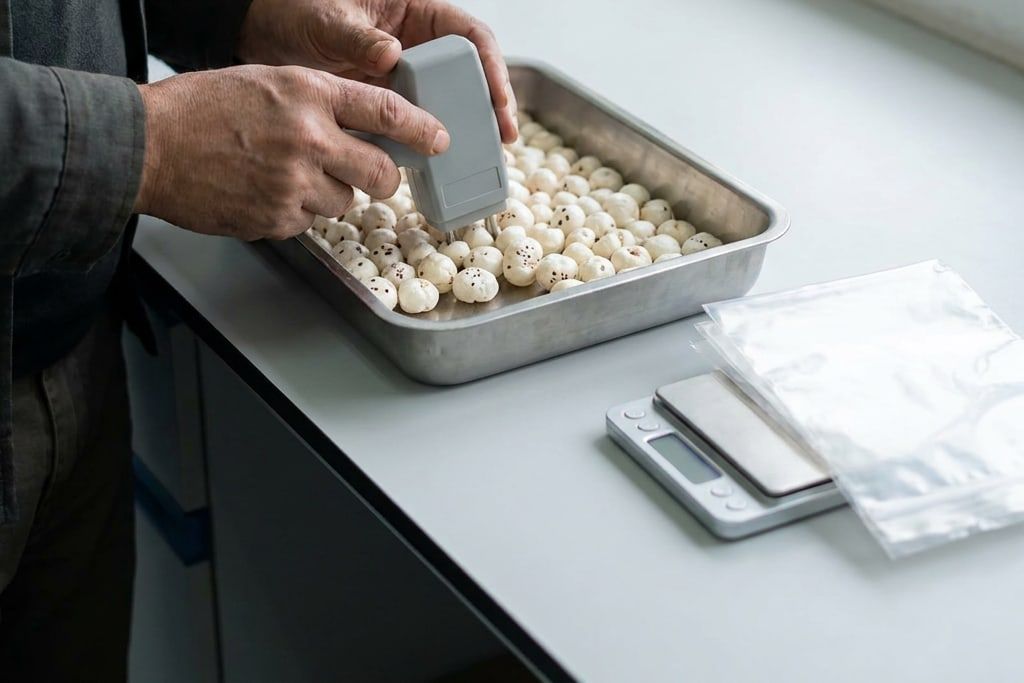
Grading is done on a sample, so the sample decides the result. A sound routine:
- Draw about 500 g from several points in the lot, not from the top of one bag.
- Size the draw with a calliper, or with sieves cut at the band edges.
- Record the share of kernels in each band, not only the band most of them fall into.
The distribution matters because a lot sold as 6 suta can carry a tail of smaller kernels and still look right at a glance. In a single-grade lot, almost all of the kernels sit inside the stated band, and the distribution on paper shows it.
Size is not the whole grade
A grade that specifies only size leaves the rest of the lot open. These are the parameters that should travel with it:
- Moisture, read on a calibrated meter. Our standard ceiling is 7%, and 4.5% on the low-moisture spec.
- Unpopped or partly popped kernels, counted on the 500 g draw.
- Broken kernels (lava), found by screening.
- Foreign matter, by weight.
- Whiteness, compared against a retained reference sample.
Our own limits are on each grade page. They tighten as the grade gets larger: we allow up to 4% unpopped and 6% broken in 4 suta, and 2% and 3% in 6 and 7 suta.
Blending
In the traditional Bihar trade, makhana is sold in gunny bags priced by volume, with every size mixed together. The buyer cannot check a bag without emptying and sieving it, so the bag is priced down towards its worst content. ICRIER’s 2025 study for APEDA names the mixing of lower grades into higher ones as a cause of rejections by importing countries.
Blending is the practice a grade specification exists to prevent. It usually happens at packing, after grading is done, which is why the grade on the certificate should be checked against the bags that arrive, not only against the sample you approved.
Choosing a grade for the job
- Flavoured and seasoned snacks: 4 suta, the grade APEDA describes as widely used in flavouring.
- Vrat and fasting products: 4 suta.
- Everyday roasted and plain packs: 5 suta, APEDA’s regular snacking grade.
- Packs where the kernel is on show: 6 suta.
- Anything that specifies the largest size by name: 7 suta.
If you are unsure, ask for samples of two adjacent grades and run them side by side on your own line.
Writing a grade into a purchase order
A grade line that leaves no room for argument names:
- The suta grade and the millimetre band, for example “6 suta, 18 to 21 mm diameter”.
- The measurement method: calliper or sieve, on a 500 g draw taken from several points in the lot.
- The minimum share of kernels that must fall inside the band.
- Limits for unpopped, broken and foreign matter.
- The moisture ceiling, and that it applies at dispatch, not at intake.
- Any laboratory tests required, and the limits for each.
- How long a retained sample is kept, and which laboratory settles a dispute.
That is a longer line than “6 suta, 10 bags”. It is also a line both sides can check a delivery against, which is the point of having a grade at all. For the checks themselves, see how to check makhana quality before buying in bulk.
Sources
- ISEC Policy Brief 70, Suta-based measurement system, Table 1: the suta unit, trade names and diameter ranges, and the 2024-25 Bihar wholesale spread. PDF
- APEDA Market Intelligence Cell, makhana dashboard, November 2025 edition: commercial grade bands and use descriptions. PDF
- ICRIER and APEDA, Strategies to Boost India’s Makhana Exports, May 2025: grade mixing as a cause of import rejections. PDF