How to check makhana quality before buying in bulk
There is no national grade standard for makhana, so quality is whatever you and your supplier write down and then check. This guide sets out an incoming-QC routine you can run on a sample kit and on every delivery, the laboratory tests worth paying for, and the signs that a supplier cannot back its own specification.
Start with a written specification
No BIS, Agmark or FSSAI grade standard exists for makhana. If the specification is not on paper, there is nothing to reject a lot against. At minimum it should name:
- the grade as a suta name and a millimetre band, for example 6 suta, 18 to 21 mm;
- the measurement method and sample size;
- limits for moisture, unpopped, broken and foreign matter;
- which laboratory tests apply and their limits;
- your incoming-QC window and how disputes are settled.
If the grade names are unfamiliar, read what suta means first.
Draw a representative sample
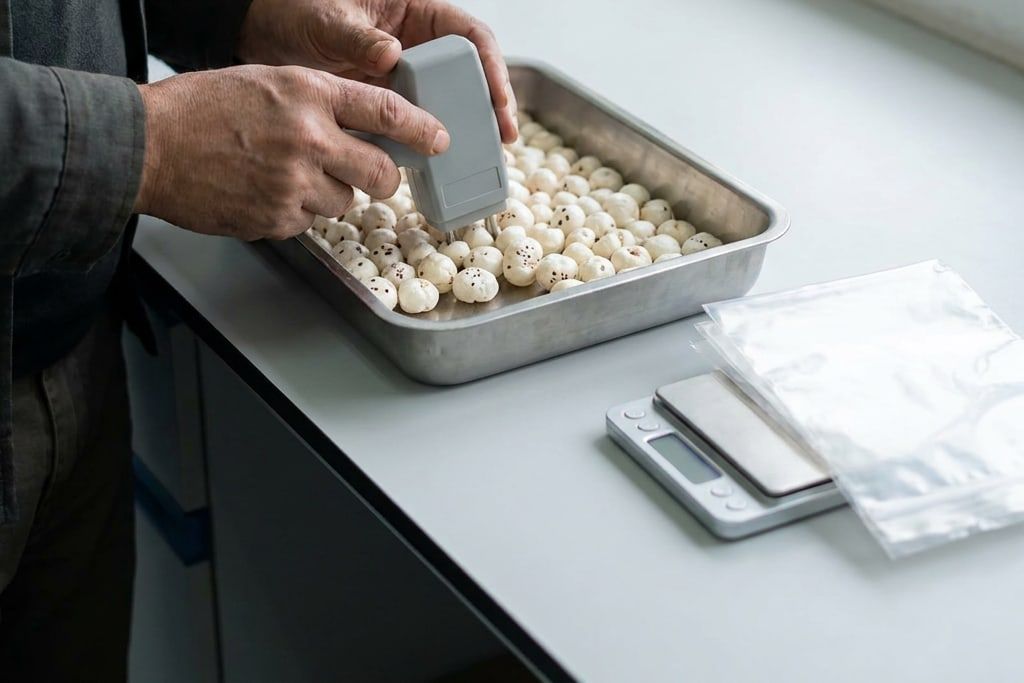
Every check below depends on the sample. Take it from several bags and from several points in each, not from the top of one bag, and combine it into a draw of about 500 g. Label it with the lot ID from the bags. If you can, keep a second sealed portion of the same draw: if the lot is disputed later, you will want to show exactly what you tested.
Size
Size the draw with a calliper, or with sieves cut at the band edges, and record how the kernels split across the bands. A lot sold as one grade should have almost all of its kernels inside the stated band. A spread across two or three bands is a blended lot, whatever the label says. Our grade pages list the band and limits for each suta grade.
Unpopped, partly popped and broken kernels
Count the unpopped and partly popped kernels in the 500 g draw and express them as a share of the count. Screen the draw for broken kernels (the trade calls them lava). For reference, our own limits run from 4% unpopped and 6% broken in 4 suta down to 2% and 3% in 6 and 7 suta.
Foreign matter
Pick out anything that is not makhana: husk, stones, fibre, dust. Weigh it against the draw. Our limit is 0.1% by weight for every grade, and it is a reasonable ceiling to write into any specification.
Moisture
Read moisture on a calibrated meter, and note which meter and when it was last calibrated. Then ask your supplier the same question. A reading without a named instrument is a number, not a measurement.
Timing matters as much as the instrument. A supplier’s intake reading tells you how the lot arrived at their store; it says nothing about the lot you receive. Ask for the dispatch reading, taken when the lot is packed for you, and compare it with your own on arrival. Our standard ceiling is 7%, with 4.5% on the low-moisture specification.
Whiteness and appearance
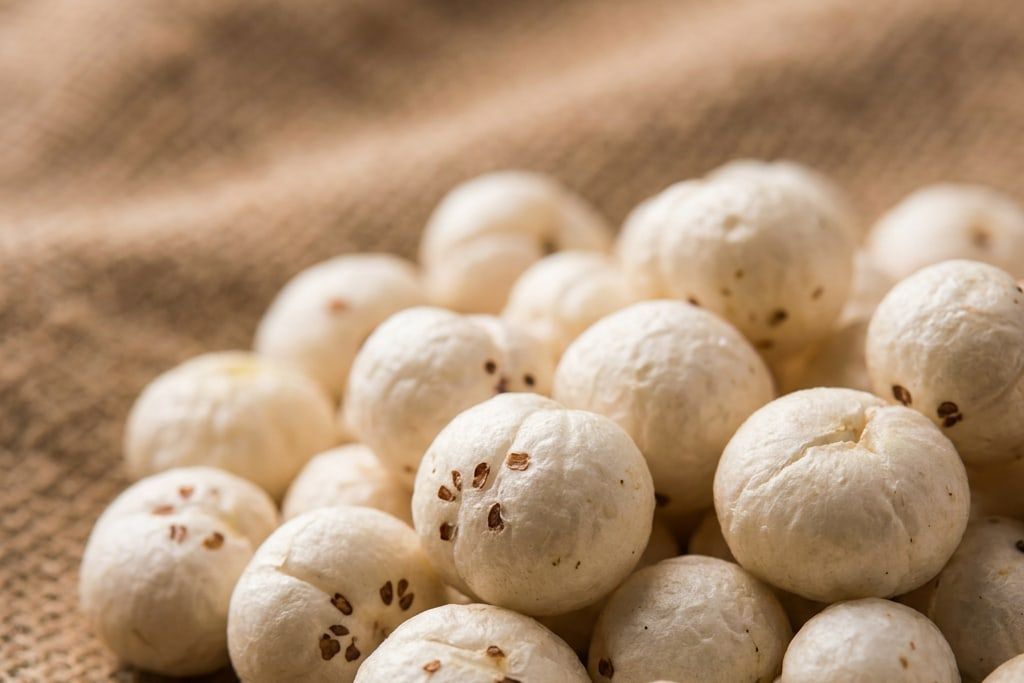
Colour is hard to put a number on without equipment, so compare instead. Keep the approved sample as your reference, and set each delivery beside it under the same light. Record any difference in writing with a photograph, the same day.
Laboratory tests
Three groups of tests matter for makhana. Use an NABL-accredited laboratory, and check that the specific test sits within that laboratory’s accredited scope, not only that the laboratory is accredited.
- Microbiology: total plate count, yeast and mould, Salmonella and E. coli. Worth running on every lot of a product that is eaten without further cooking.
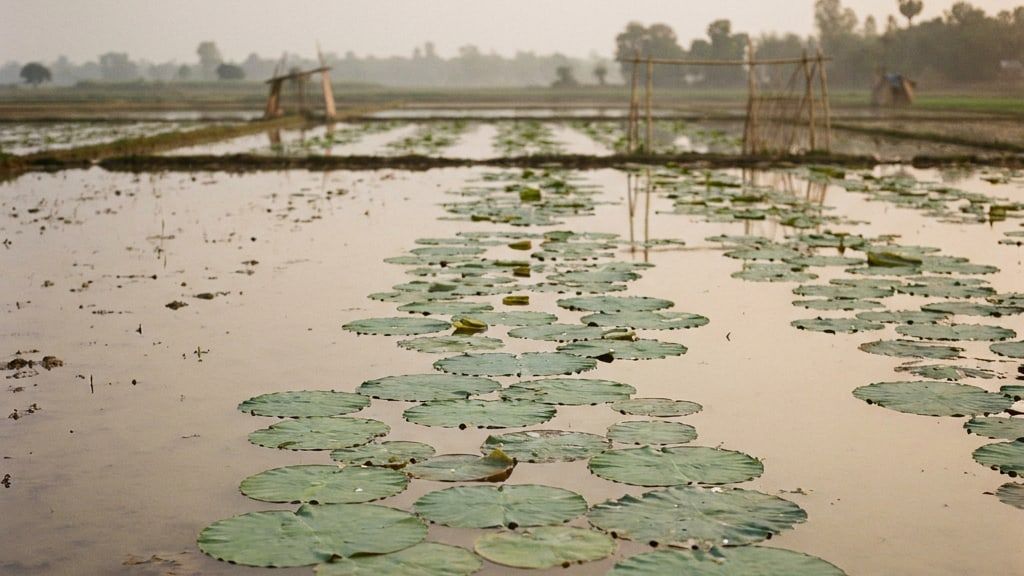
- Aflatoxin B1 and total. Makhana is harvested from pond beds, dried in the open and can sit in ambient storage for months. That is a known exposure profile for aflatoxin, and there is no makhana-specific FSSAI or Codex maximum and no published incidence survey for Bihar makhana. Agree a limit in the contract rather than assume one.
- Pesticide multi-residue by LC-MS/MS, mainly for product going to strict export markets.
If you sell into the EU, the reference specification is Commission Implementing Regulation (EU) 2023/652, which authorised roasted and popped Euryale ferox as a traditional food. Its limits include:
| Parameter | EU limit |
|---|---|
| Moisture | below 5.0% |
| Aflatoxin B1 | 2.0 µg/kg or lower |
| Aflatoxin total | 4.0 µg/kg or lower |
| All pesticides | 0.01 mg/kg default limit |
| Microcystins | 0.0015 mg/kg or lower |
| Salmonella, Listeria monocytogenes | absent in 25 g |
The microcystin limit is the one to watch for a pond-grown crop: it is a toxin from cyanobacteria in water. Makhana flour is not covered by the authorisation.
The certificate of analysis
A certificate of analysis is only useful if it is tied to the lot and issued before dispatch. Check three things:
- The lot ID on the certificate matches the lot ID on the bags.
- The certificate is dated before the lot left the supplier. A certificate issued after dispatch is a receipt, not a control.
- It reports measured values, including the size distribution and the dispatch moisture, not just “conforms”.
Retained samples and disputes
Your supplier should hold a retained sample from every lot, for a period written into the contract. We keep ours for 12 months. Agree in the contract, before any dispute, which laboratory will test a coded duplicate if your results and the supplier’s disagree, and that its result is binding. Naming the laboratory in the middle of an argument looks like shopping for an answer.
Agree the incoming-QC window as well. Ours is 5 working days from delivery; past that, a lot is treated as accepted.
Red flags in a supplier
- Quotes by the bag rather than by weight and grade.
- A grade name with no size distribution behind it.
- Moisture from intake only, or with no meter named.
- A certificate dated after dispatch, or not tied to a lot ID.
- No retained sample, or reluctance to name a referee laboratory.
- Visibly mixed sizes within one bag.
- Cash-only or unbilled terms, which leave you nothing to claim against.
An incoming-QC checklist
- Match the lot ID on the bags to the certificate.
- Draw about 500 g from several bags and points; seal a second portion.
- Size the draw and record the distribution by band.
- Count unpopped and partly popped; screen for broken.
- Pick and weigh foreign matter.
- Read moisture on a calibrated meter and compare with the dispatch reading.
- Compare colour against the approved sample; photograph any difference.
- Send laboratory samples as the contract requires.
- Report any failure inside the QC window, with data and method.
A sieve and a moisture meter on every delivery cost far less than a rejected batch of finished product. For how we run these checks at origin, see quality.
Sources
- Commission Implementing Regulation (EU) 2023/652, Official Journal L 81, 21 March 2023: EU specification for roasted and popped Euryale ferox. PDF
- APEDA Market Intelligence Cell, makhana dashboard, November 2025 edition: commercial grade bands. PDF
- ICRIER and APEDA, Strategies to Boost India’s Makhana Exports, May 2025. PDF