Buying makhana from Bihar: a buyer's guide to sourcing
Most of India’s makhana comes from the pond belt of north Bihar. This guide covers the parts of the Bihar trade that affect a bulk buyer: where makhana is grown, how the season runs, where it trades, why there is no published wholesale price, what freight really costs, and what to ask a supplier before the first order.
Where it is grown
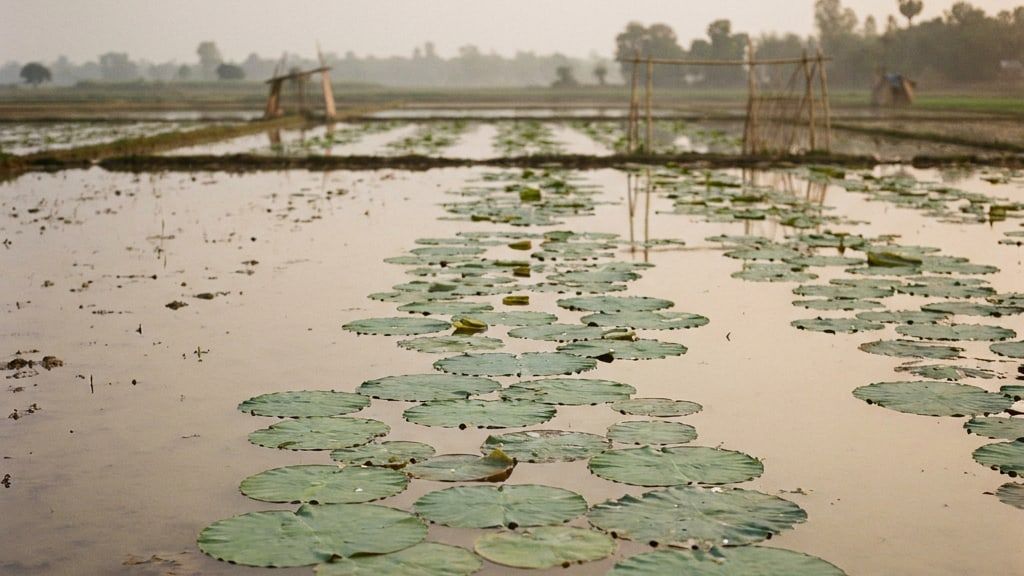
Makhana is the popped seed of Euryale ferox, a water plant grown in ponds and in fields. In Bihar the main districts are Darbhanga and Madhubani in Mithila, and Purnia, Katihar, Supaul and Saharsa further east.
Mithila Makhana carries a Geographical Indication. It is a collective regional tag covering thousands of producers across those districts. It tells you where the makhana was grown; it tells you nothing about how a particular lot was graded, dried or stored. Treat a GI mention as provenance, and check the lot on its own measurements.
How it gets from pond to bag
Growers harvest the seed from the pond bed at the end of the season. The seed, called guri in the trade, is then roasted and popped. Popping and hand-sorting are skilled, traditional work, much of it done in household processing clusters in Mithila. Aggregators and traders collect the popped makhana and sell it on through the market towns.
That chain matters to a buyer for two reasons: every hand it passes through is a chance for sizes to be mixed, and much of the processing is informal, which raises the social-compliance question covered below.
The season
In the pond system, harvest runs from August to October. The field system compresses the crop and harvests in August. Popping follows harvest.
For the rest of the year the market runs on stored stock. APEDA stated that from November 2025 through August 2026 the Indian market would rely entirely on stored popped makhana, and called storage quality and inventory management critical for the months ahead. For a buyer, that means most purchases outside the harvest window are of makhana popped weeks or months earlier. Ask when a lot was popped and how it was stored, and measure moisture on arrival rather than trusting an old reading.
Demand has its own calendar: Sawan in July and August, Navratri in September and October and again in March and April, Diwali, and the wedding season from November to February. Book ahead of the window you are buying for.
Where makhana trades
- Darbhanga and Madhubani. Gullobara bazar in Darbhanga and Madhubani town are the Mithila trading points.
- Harda Bazaar, on the Purnia and Katihar boundary. With more than a hundred makhana factories around it, it is the price-setting point for the country.
- Khari Baoli, Delhi. Downstream, this is where the loose-trade price is set, and where many brand buyers are based.
- Kanpur and Varanasi. Secondary downstream markets at Nayaganj in Kanpur and Gola Dinanath and Vishweshwarganj in Varanasi.
How the traditional trade sells: the Bora system
Popped makhana in the Bihar trade is traditionally sold in Bora: gunny bags of a fixed size, 27 by 44 or 28 by 46 inches, loosely and variably packed, with every size blended together. The price is set per bag, by volume, not by weight or grade.
A buyer cannot check a bag without emptying and sieving it, so each bag is priced down towards its worst content. A seller with good material is averaged down, and a buyer gets lots that vary from one delivery to the next. If your product needs consistent size, buy by weight against a declared size distribution, and check it on arrival. Our guide on checking makhana quality sets out how.
Why there is no published wholesale price
People search for a makhana wholesale price and find numbers, but none of them is a market series. No mandi anywhere in India records makhana, so there is no Agmarknet price for it. There is no futures contract, no forward market and no way to hedge the price. Every figure in circulation is a trade quote, a survey estimate, or a seller’s asking price on a listing site, and published sources disagree with each other.
Prices also move within a season, with arrivals and with festival demand. So the useful question is not “what is the rate” but “what is your rate today, for this grade, this band, this moisture, this lot size and this dispatch date, in writing”. A quote that specifies all six can be compared with another. One that does not cannot.
Freight: makhana is bulky
Popped makhana is very light for its volume. Its bulk density is about 70 to 90 kg per cubic metre, so a tonne takes up roughly 7 to 10 cubic metres. A truck fills by volume long before it reaches its weight limit. Any freight rate worked out per tonne on the assumption of a normal 10 to 20 tonne payload will understate what you actually pay. Ask for freight on volume, and check it against weight.
The same physics applies to export. A 40-foot high-cube container holds only about 4 tonnes of popped makhana. That is why we quote export on FOB terms only: the buyer, who controls the freight, carries its volume cost.
Tax classification
India has no dedicated tariff line for makhana. The code HSN 20081910, which is sometimes quoted for it, is roasted cashew. Confirm the HSN and GST treatment for your product with your tax adviser before you build it into a price.
Social compliance
ICRIER’s study for APEDA names child labour as an issue in traditional makhana processing, and one that affects exports. If you sell to retailers or overseas buyers who audit their supply chains, make it a condition of supply. Ask for a written clause in your supplier’s processing agreements covering no workers under 18, a signed declaration from the processing unit, a right of unannounced inspection, and a workforce record for each shift. Every processing agreement we sign carries that clause.
Payment
Expect to pay in advance, or part in advance, on a first lot, and to move to short credit only after a few clean deliveries. Avoid cash and unbilled purchases: without an invoice and a certificate tied to the lot, you have nothing to claim against if it fails.
Questions to ask before the first order
- Is each lot a single grade, and what is its millimetre band?
- How is size measured, on what sample, and will you report the distribution?
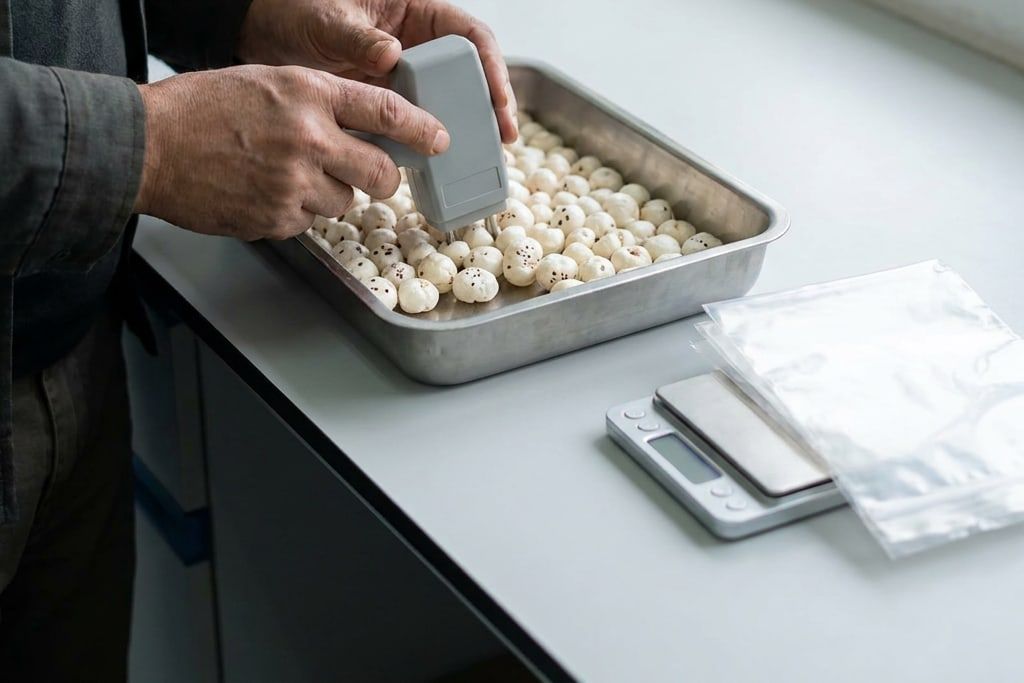
- What is the moisture at dispatch, and on which calibrated meter?
- Which laboratory tests do you run, at which NABL-accredited laboratory, and how often?
- Is the certificate of analysis issued before dispatch, and is it tied to the lot ID on the bags?
- How long do you keep a retained sample, and which laboratory settles a dispute?
- What happens if the lot fails my incoming QC?
- Where was the lot popped, when, and under what social-compliance terms?
- How is freight quoted?
A supplier who answers all nine in writing is one you can build a specification with. See our grades and bulk supply terms for our own answers.
Sources
- ISEC Policy Brief 70, Suta-based measurement system: the Bora system and volume pricing. PDF
- APEDA Market Intelligence Cell, makhana dashboard, November 2025 edition: reliance on stored popped makhana from November 2025 to August 2026. PDF
- ICRIER and APEDA, Strategies to Boost India’s Makhana Exports, May 2025: value chain, processing and child labour in traditional processing. PDF